


As vehicle security systems become ever more sophisticated, it can be difficult for hard-pressed fleet managers to find the time to get their heads round the different options and differentiate between ADAS and AI alternatives.
In this post, we look at some of them and explain how they help to safeguard your fleet and other road users.
The evolution of both ADAS (Advanced Driver Assistance Systems) and AI (Artificial Intelligence) has revolutionized commercial vehicle safety. They can work in tandem or separately, but it’s important to understand what each one is capable of.
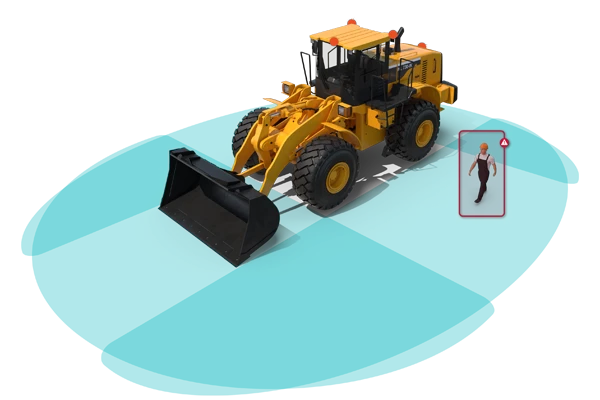
ADAS uses automated technology, such as cameras and sensors, to detect obstacles or pick up on driving errors and provide an appropriate response. This can range from creating a warning system to taking control of the vehicle. At a basic level, it can consist of a collision warning system which alerts the driver to a hazard, but the onus is on them to rectify the problem. This is referred to as L0 ADAS. A forward collision warning which detects a hazard and then applies the vehicle’s brakes could be L2-L4 ADAS, depending on the integration. It’s an advanced technology, but it repeats its function without using the experience to improve on it.
As an example of how ADAS and AI cameras work, let’s imagine an HGV is delivering a consignment of food and reversing into ‘goods in’ at a town center supermarket. An ADAS camera will pick up on someone entering the loading bay and alert the driver accordingly, but there’s also the possibility of it spotting a bollard or a cage full of veg boxes – the driver won’t know the difference from the warning.
However, add an AI camera into the scenario and the driver will be able to differentiate between the supermarket employee and veg boxes and act accordingly. If this is a regular delivery site, an AI camera can have solutions built into it which remember where an inconvenient pillar is, or a door from which people are likely to appear.
What type of system will best suit your fleet?
Radar Detection
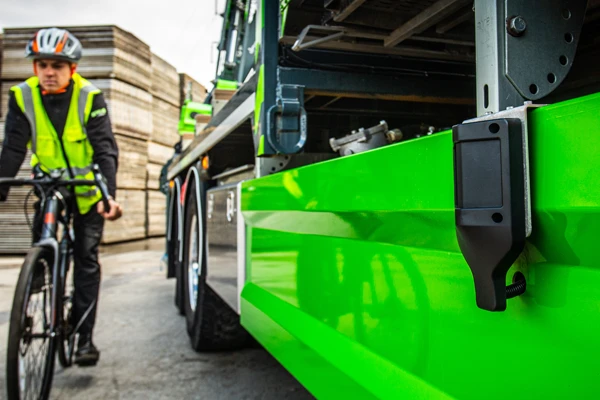
Brigade’s Backsense® Radar Ostacle Detection, which is an ADAS product, detects objects in blind spots, and provides the driver with in-cab visual and audible warnings. Our Radar Predict, however, uses AI technology to differentiate between, for example, a cyclist and a street lamp, and will analyze data such as the speed of the cyclist and the direction in which they are going. This information is then used to calculate the likelihood of a collision and alert the driver accordingly. The extra input means that false alerts are reduced, decreasing the chances of a driver becoming desensitized to warnings and starting to ignore them.
360-degree Cameras
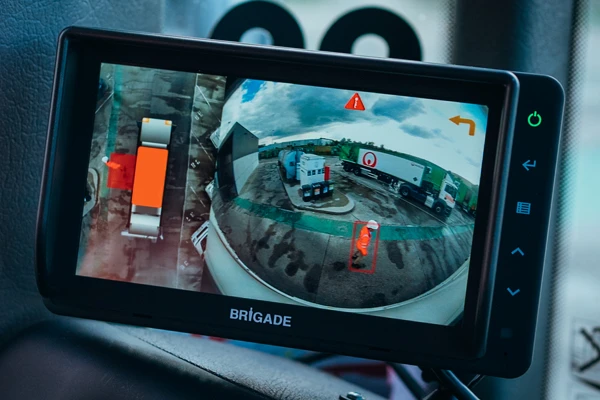
Our 360-degree high-definition four-camera system – Backeye®360 AI Intelligent detection – is enhanced by state-of-the-art AI technology to identify humans and effectively eliminate all blind spots. Providing a comprehensive view of the surrounding area in a single image, Backeye®360 AI audibly and visually alerts the driver when a person is detected, eliminating blind spots and actively saving lives.
Telematics

A telematics package is another option for responsible fleet operators. Telematics is a branch of information technology that deals with the long-distance transmission of computerized information. For commercial vehicles, this is a combination of GPS systems, onboard diagnostics and wireless devices which transmit data such as speed, location, maintenance requirements and any information which contributes to the safety of the vehicle and its driver, such as the location of vulnerable road users with which they come into contact.
Each industry sector will have different requirements, and a provider should help you to work out the right package for your specific needs.
How Brigade Can Help
Here at Brigade, we’ve been helping to safeguard both commercial drivers and vulnerable road users since our foundation in 1976. All our vehicle safety products are certified to ISO9001:2015, and our principal manufacturing facilities are certified to IATS 16949:2016.
Why not contact us if you’d like to find out how our AI and ADAS safety solutions could benefit your fleet?