

Tout ce qu'il faut savoir sur l'indice de protection IP
Qu'est-ce qu'un indice de protection IP ?
L'indice IP (Indice de protection contre les infiltrations) est une norme internationalement reconnue qui indique le niveau de protection d'un produit électrique contre la pénétration de poussière, de saleté et d'eau.
Élaborée par la Commission électrotechnique internationale (CEI) et définie dans la norme EN 60529, la Système de classification IP aide les utilisateurs à déterminer dans quelle mesure un produit est adapté à différents environnements d'exploitation.
Dans le domaine des systèmes de sécurité automobile, les caméras, les écrans, les capteurs et autres composants électroniques sont souvent exposés à la pluie, à la poussière, à la boue, au lavage à haute pression et à des conditions de fonctionnement difficiles. Choisir des équipements dotés d'un indice de protection IP adapté permet de garantir des performances fiables et une longue durée de vie.

Que signifient les adresses IP ?
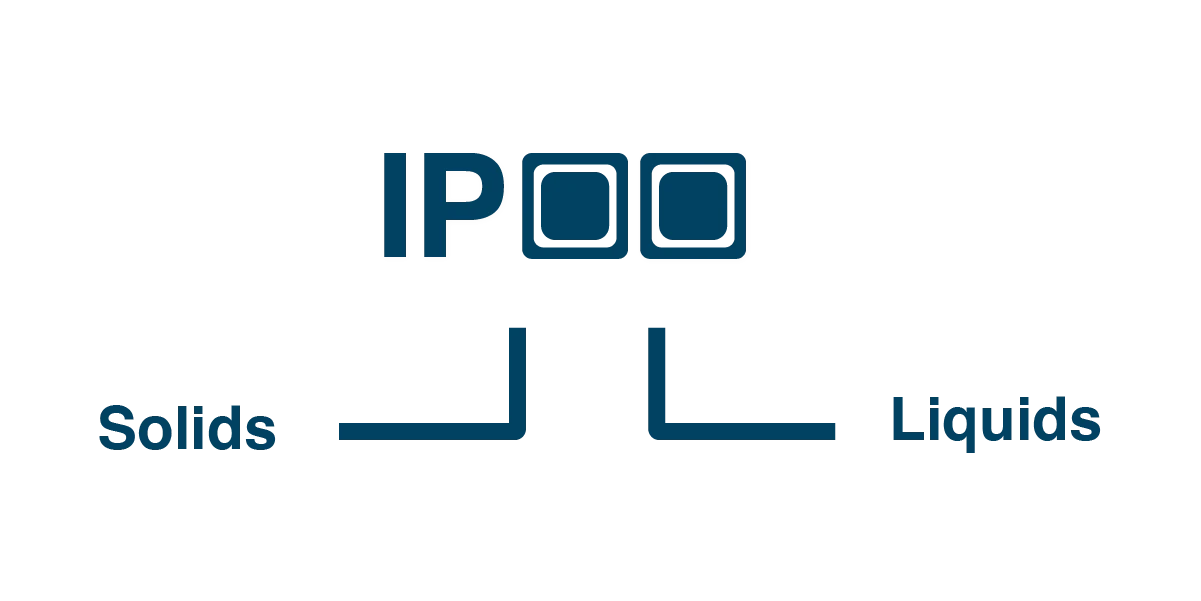
Un indice de protection IP se compose de deux chiffres :
IP69K (par exemple)
- Premier chiffre : Protection contre les corps solides et la poussière
- Deuxième chiffre : Protection contre l'eau et l'humidité
Plus le chiffre est élevé, plus le niveau de protection est élevé.

Protection contre les infiltrations

Protection contre les corps solides

Protection contre les liquides

Lettre complémentaire
"La lettre " K » désigne une protection adaptée aux applications de lavage à haute pression et à haute température.
Premier chiffre : protection contre les corps solides
Deuxième chiffre : protection contre les liquides
Tableau de classement IP
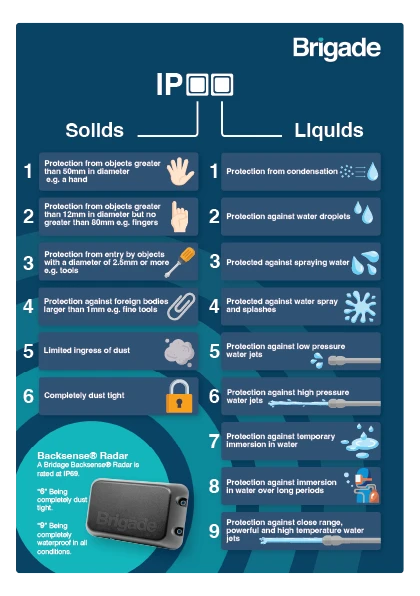
Lorsqu'on compare des produits, un tableau des indices de protection IP permet de se faire rapidement une idée du niveau de protection offert contre la poussière et l'eau.
Dans les secteurs exigeants tels que la construction, l'exploitation minière, la gestion des déchets et l'agriculture, on privilégie souvent les produits classés IP67, IP68 ou IP69K en raison de leur capacité à résister à des conditions environnementales difficiles.
 |
Protection contre les objets d'un diamètre supérieur à 50 mm, par exemple une main |
 |
Protection contre la condensation |  |
 |
Protection contre les objets d'un diamètre supérieur à 12 mm mais n'excédant pas 80 mm, par exemple les doigts. |  |
Protection contre les gouttes d'eau |  |
 |
Protection contre la pénétration d'objets d'un diamètre de 2,5 mm ou plus, par exemple des outils |  |
Protégé contre les projections d'eau |  |
 |
Protection contre les corps étrangers d'une taille supérieure à 1 mm, par exemple les outils fins |  |
Protégé contre les projections d'eau et les éclaboussures |  |
 |
Pénétration limitée de la poussière |  |
Protection contre les jets d'eau à basse pression |  |
 |
Totalement étanche à la poussière |  |
protection contre les jets d'eau à haute pression |  |
 |
Protection contre l'immersion temporaire dans l'eau |  |
||
 |
Protection contre l'immersion dans l'eau pendant de longues périodes |  |
||
 |
Protection contre les jets d'eau proches, puissants et à haute température |  |
Qu'est-ce que la norme IP69K ?
La norme IP69K est l'un des indices de protection les plus élevés disponibles pour les systèmes électroniques des véhicules utilitaires.
Les produits classés IP69K sont les suivants :
- Entièrement étanche à la poussière (IP6X)
- Résistant aux jets d'eau à haute pression et à haute température (IPX9K)
- Convient aux environnements extérieurs difficiles
- Idéal pour les véhicules et les machines régulièrement nettoyés au jet haute pression
De nombreuses caméras Brigade sont certifiées IP69K, ce qui garantit des performances fiables dans des conditions d'utilisation difficiles. Par exemple, Les caméras IA de Brigade et Backeye®360 AI Ces caméras sont certifiées IP69K, ce qui les rend adaptées aux véhicules utilitaires et aux engins mobiles utilisés dans des environnements difficiles.
Choisir l'indice de protection IP adapté
Lorsque vous choisissez des équipements de sécurité pour votre véhicule, tenez compte des éléments suivants :
- Exposition à la poussière, à la boue ou aux débris
- Utilisation en extérieur par tous les temps
- Exigences relatives au nettoyage à haute pression
- Environnement d'exploitation et type de véhicule
Un indice IP plus élevé offre généralement une meilleure protection et une plus grande durabilité, ce qui permet de maintenir les performances dans des conditions difficiles.