
Spiegazione della classificazione IP
Che cos'è un grado di protezione IP?
Il grado di protezione IP (Ingress Protection) è uno standard riconosciuto a livello internazionale che indica il livello di protezione di un prodotto elettrico contro la penetrazione di polvere, sporcizia e acqua.
Sviluppato dalla Commissione Elettrotecnica Internazionale (IEC) e definito dalla norma EN 60529, il Sistema di classificazione IP aiuta gli utenti a capire quanto un prodotto sia adatto a diversi ambienti operativi.
Nel campo dei sistemi di sicurezza per veicoli, telecamere, monitor, sensori e altri componenti elettronici sono spesso esposti a pioggia, polvere, fango, lavaggi ad alta pressione e condizioni operative difficili. Scegliere apparecchiature con il giusto grado di protezione IP contribuisce a garantire prestazioni affidabili e una lunga durata.

Cosa significano gli indirizzi IP?
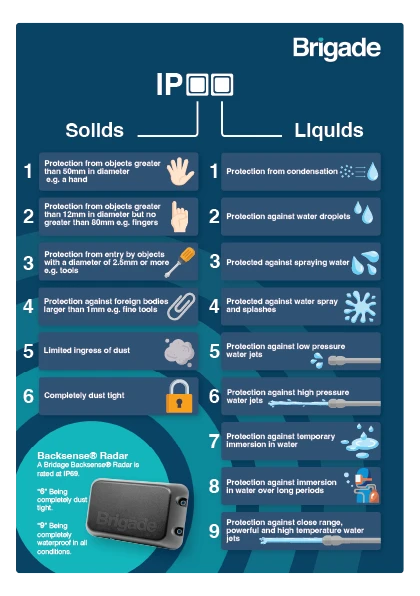
Un grado di protezione IP è composto da due cifre:
IP69K (ad esempio)
- Prima cifra: Protezione contro oggetti solidi e polvere
- Seconda cifra: Protezione dall'acqua e dall'umidità
Più alto è il numero, maggiore è il livello di protezione.

IP

Protezione dei solidi

Protezione dai liquidi

Lettera integrativa
"La lettera "K" indica la resistenza alle applicazioni di lavaggio ad alta pressione e ad alta temperatura.
Prima cifra: protezione contro i corpi solidi
Seconda cifra: protezione contro i liquidi
Tabella dei valori IP
Quando si confrontano i prodotti, una tabella dei gradi di protezione IP offre un rapido riferimento per comprendere il livello di protezione offerto contro polvere e acqua.
In settori particolarmente esigenti come l'edilizia, l'estrazione mineraria, la gestione dei rifiuti e l'agricoltura, si preferiscono spesso prodotti con grado di protezione IP67, IP68 o IP69K, grazie alla loro capacità di resistere a condizioni ambientali difficili.

 |
Protezione da oggetti di diametro superiore a 50 mm, ad esempio una mano. |
 |
Protezione dalla condensa |  |
 |
Protezione da oggetti di diametro superiore a 12 mm ma non superiore a 80 mm, ad esempio le dita. |  |
Protezione contro le gocce d'acqua |  |
 |
Protezione dall'ingresso di oggetti di diametro pari o superiore a 2,5 mm, ad esempio utensili. |  |
Protezione contro gli spruzzi d'acqua |  |
 |
Protezione contro i corpi estranei di dimensioni superiori a 1 mm, ad esempio utensili di precisione |  |
Protezione da spruzzi e schizzi d'acqua |  |
 |
Ingresso limitato di polvere |  |
Protezione contro i getti d'acqua a bassa pressione |  |
 |
Completamente a tenuta di polvere |  |
Protezione contro i getti d'acqua ad alta pressione |  |
 |
Protezione contro l'immersione temporanea in acqua |  |
||
 |
Protezione contro l'immersione in acqua per lunghi periodi |  |
||
 |
Protezione contro i getti d'acqua a distanza ravvicinata, potenti e ad alta temperatura |  |
Che cos'è l'IP69K?
IP69K è uno dei livelli di protezione più elevati disponibili per l'elettronica dei veicoli commerciali.
I prodotti con grado di protezione IP69K sono:
- Completamente a tenuta di polvere (IP6X)
- Resistente ai getti d'acqua ad alta pressione e ad alta temperatura (IPX9K)
- Adatto ad ambienti esterni difficili
- Ideale per veicoli e macchinari sottoposti regolarmente a lavaggio a pressione
Molte telecamere Brigade sono classificate IP69K, il che garantisce prestazioni affidabili in condizioni operative difficili. Ad esempio, Telecamere con intelligenza artificiale Brigade e Backeye®360 AI Le telecamere sono classificate IP69K, il che le rende adatte a veicoli commerciali e macchinari mobili che operano in ambienti difficili.
Scegliere il grado di protezione IP corretto
Quando si scelgono i dispositivi di sicurezza per i veicoli, occorre tenere presente quanto segue:
- Esposizione a polvere, fango o detriti
- Funzionamento all'aperto in qualsiasi condizione atmosferica
- Requisiti per il lavaggio a pressione
- Ambiente operativo e tipo di veicolo
Un grado di protezione IP più elevato garantisce in genere una maggiore protezione e durata, contribuendo a mantenere le prestazioni anche in condizioni difficili.